
Spanish nationality status: check your application («Cómo va lo mío»)
You have applied for Spanish citizenship and want to know where it stands? Here is the official link to check your Spanish nationality status, what each status really means (in plain English), how long it usually takes and what to do if it gets stuck. Haven’t applied yet? We also explain how to apply for Spanish nationality step by step, on your own or with a lawyer.
Check your nationality application («Cómo va lo mío»)
In under a minute you can see what stage your application is at. You don’t need Cl@ve or a digital certificate: just the four details in the example.
Check my application ↗«Cómo va lo mío»: what it is and where to check your Spanish citizenship application
«¿Cómo va lo mío?» («how is my case going?») is the name everyone still uses for the Ministry of Justice service where you check the status of your nationality application. Its official name today is Consulta telemática de expedientes de nacionalidad española por residencia, and it is on the Ministry’s electronic office (Sede Electrónica). Same service, different name: if someone in a forum tells you to «check cómo va lo mío», this is the link they mean.
Two things worth knowing before you go in:
- It is for nationality by residence. If you applied by option, by «carta de naturaleza» or under the Democratic Memory Law (the «grandchildren» route), you follow it up with the Civil Registry or the consulate where you applied.
- It is not the immigration (extranjería) status check. Your TIE, arraigo or renewal are checked on the immigration office’s website, not here. For nationality, only the Ministry of Justice link works.

What does each Spanish nationality status mean?
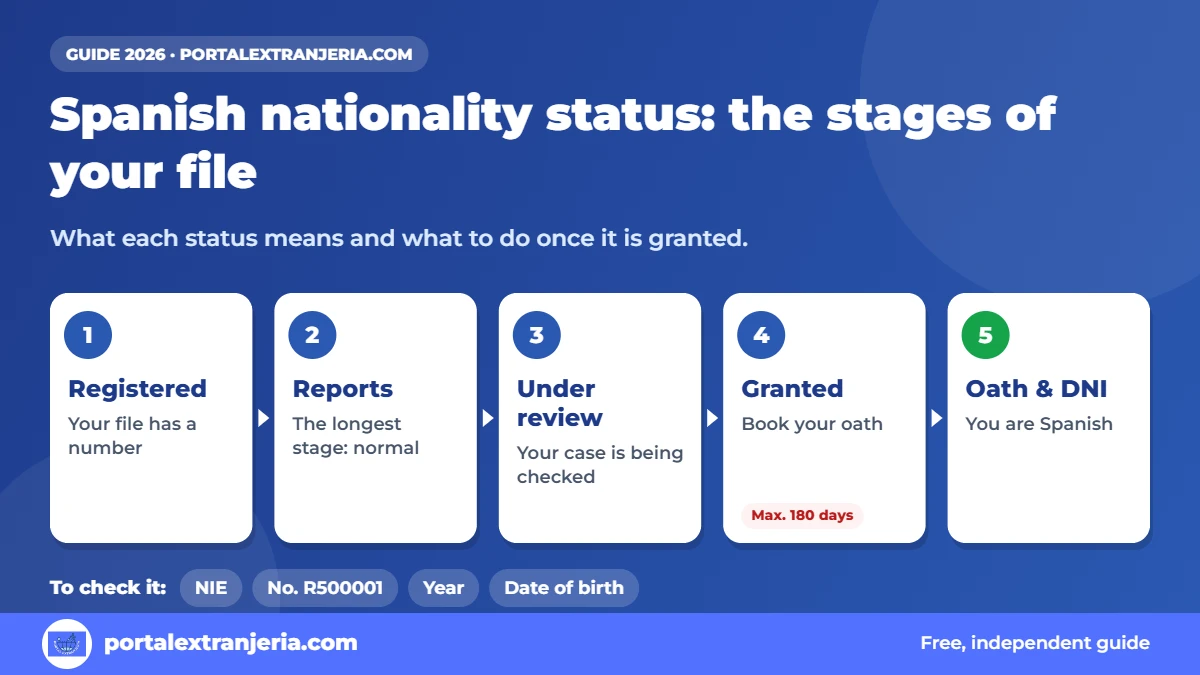
When you check your Spanish nationality status, you get some rather dry phrases in Spanish. This is what they actually mean, in the order they usually appear:
- Abierto · Registrado / grabado (open, registered): your application is in the system and has a number. Now you wait your turn.
- En tramitación (being processed): the file is moving. It is a generic status and can last a long time with nothing visible happening.
- Pendiente de informes solicitados (awaiting reports): the Ministry has asked other bodies for reports (criminal records, Police, intelligence service…). It is usually the longest stage and the most nerve-racking. It’s normal.
- En calificación / en estudio (under review): the reports are in and an official is reviewing your case. Good sign: you are close to a decision.
- Requerimiento (request for documents): they need something that’s missing or not valid (an expired certificate, a translation…). Reply within the deadline stated in the notification: if you don’t, your file can be closed.
- Concedida (granted): congratulations! From the day you are notified you have 180 days to swear or promise allegiance at the Civil Registry or before a notary. It’s not at the police station: you go there afterwards, for your DNI. We cover it all in what to do once it is granted.
- Denegada (refused): the decision explains why. You can file an appeal for reconsideration («recurso de reposición») within one month or go straight to the courts within two months. Here we do recommend talking to an immigration lawyer.
- Archivada (closed): this usually happens when a document request wasn’t answered in time or the application was withdrawn. Depending on the case, you can appeal or you have to apply again.
How long does Spanish nationality by residence take?
By law the Ministry has one year to decide, counted from when your application reaches the office handling it. In real life it depends a lot on the year you applied, how you applied and whether they ask you for documents along the way: some people get it in under a year and others wait quite a bit longer. So don’t panic if someone else got theirs sooner.
💡 What if a year goes by with no answer?
It is treated as refused by administrative silence, which opens the door to taking it to court. Many people do exactly that to get their file decided once and for all. It’s a step best taken with a lawyer.
While you wait, don’t neglect this:
- Renew your TIE on time. Having a nationality application in progress doesn’t protect you if your residence permit expires. If it’s time to renew, here are the immigration forms and the 790 012 fee.
- Keep your padrón and notification details up to date. If they send you a document request and it doesn’t reach you, the deadline still runs.
- Avoid long absences from Spain. Your residence has to be continuous; spending many months abroad can cause problems.
Your application doesn’t show up? Common mistakes when checking
The «no existen datos» (no data found) message is scary, but there’s almost always a silly explanation. Go through this before you worry:
- You put the year inside the number. «Número» is just R500001; the year goes in its own box.
- You left out the R or added spaces. Type it in capitals, right next to the digits.
- Your NIE is incomplete: it’s missing the first or last letter.
- Your date of birth doesn’t match the one in the application (this happens a lot when a document has an error).
- Your file hasn’t been registered yet. If you only just applied, it can’t be checked yet. Give it a few weeks.
- The website is overloaded. Sometimes it just fails. Try early in the morning or at night, and from another browser.
If after all this it still doesn’t appear and quite some time has passed, there may be a mistake in how your details were entered. That’s when it’s worth having someone look at your case.
How to apply for Spanish nationality by residence: step-by-step guide
If you haven’t applied yet, this is the part for you. Getting it right from the start is the best way to make sure that, when you later check your application, you don’t find a document request that holds it up for months. This is the route:
- Check your yearsLegal, continuous residence
- ExamsCCSE and DELE A2 from the Instituto Cervantes
- DocumentsBirth and criminal record, legalised and translatedWatch expiry dates
- Fee 790 026About €104, updated every year
- Apply and waitAnd check «cómo va lo mío»
How many years of residence do you need?
They must be years of legal, continuous residence immediately before you apply. How many depends on your case:
For most nationalities.
If you have been granted refugee status.
If you are a national of origin of a Latin American country, Andorra, the Philippines, Equatorial Guinea or Portugal, or if you are Sephardic.
If you were born in Spain, have been married to a Spaniard for one year (not separated), are the widow or widower of a Spaniard, were born abroad to a father, mother, grandfather or grandmother who were Spanish by origin, or were under the guardianship or foster care of a Spaniard for two consecutive years, among other cases.
Requirements: good conduct and integration
- Good civic conduct: no criminal record in Spain or in your country of origin.
- CCSE exam (constitutional and sociocultural knowledge of Spain), run by the Instituto Cervantes.
- DELE A2 Spanish exam or higher. If you are from a country where Spanish is an official language, you don’t need it.
- Minors and some other people (for example, those who completed secondary school, ESO, in Spain) may be exempt from the exams. If you think that’s you, check before you pay any fees.
Documents they will ask for
- Valid passport (every page) and your valid TIE.
- Birth certificate from your country, legalised or apostilled and translated if it isn’t in Spanish.
- Criminal record certificate from your country, also legalised or apostilled and translated. Check its date: if it has expired when you apply, that’s a classic reason for a document request.
- Certificate of registration on the padrón (empadronamiento).
- Your CCSE and DELE diplomas, or the document proving you are exempt.
- Proof of payment of fee 790, code 026 (around €104; check this year’s amount on the Ministry of Justice website).
- Depending on your case: marriage certificate, family book, your Spanish spouse’s birth certificate, etc.
Where and how do you apply?
There are two ways. Online, on the Ministry of Justice’s electronic office: you need a digital certificate, or a lawyer or gestor can file it for you. It is the fastest option and the one where least gets lost along the way. On paper, at a public administration registry: it works, but registering the file usually takes longer. Whichever you choose, keep your receipt: you will need it.
🎉 Your nationality has been granted: what now?
When the status changes to «Concedida», it is time to celebrate (and you should, it has been a long road). But you are not fully Spanish yet: there are still a few steps with deadlines that expire and a number of paperwork changes that almost everyone leaves half done.
We went through this ourselves, so we explain it in the order you will face it, along with the mistakes we see over and over again. This is the whole journey:
- Oath or promiseAt the Civil Registry or before a notaryMax. 180 days
- Birth certificateYour birth, now registered in SpainValid 6 months
- DNI and passportFirst issue at the Police
- NIE → DNISocial Security, tax office, bank…As soon as possible
- Cl@ve and certificateWith your new DNI
1. Oath or promise: the Civil Registry clock
This is the act that officially makes you Spanish. From the day you are notified of the decision, you have 180 days to appear, swear or promise, and request your registration. It sounds like plenty of time, but many Civil Registries take months to give appointments.
⚠️ If you miss the deadline, you lose the nationality you were granted
If you do not take the oath within 180 days, the grant expires (article 21 of the Civil Code) and you would have to start the whole application again. Book the appointment the same day you receive the notification, even if they give you a date three months later.
Where do you take the oath?
- At the Civil Registry (Registro Civil) where you live. The traditional option, but in big cities the waiting list can be long.
- Before a notary. Thanks to an agreement between the Ministry of Justice and notaries, you can take the oath at a notary’s office, usually free of charge. If your Civil Registry is giving appointments months ahead, this is the fastest route. When booking, check that the notary handles nationality oaths.
What do they usually ask for?
- The decision granting you nationality.
- Your valid passport and your TIE.
- A recent certificate of registration at your address (certificado de empadronamiento).
- At some registries, your birth certificate (and marriage certificate, if you are married), legalised or apostilled and translated, if you did not provide it before. Ask for the exact list when you book: every registry does things differently.
What happens at the ceremony?
- You swear or promise loyalty to the King and obedience to the Constitution and the law.
- You renounce your previous nationality, unless you are from a Latin American country, Andorra, the Philippines, Equatorial Guinea, Portugal or France, which can keep it.
- Your name and surnames are fixed exactly as they will appear in your registration and on your DNI. In Spain you will have two surnames.
💡 Check your details before signing
Take your time to check how your name, surnames, date and place of birth and your parents’ names are written. A missing accent or a wrong letter will carry over to your birth certificate, DNI and passport, and correcting it later is another procedure that can take months.
2. Full birth certificate for the DNI (certificado literal de nacimiento)
After the oath, the Civil Registry records your birth in Spain. With that record you can request the full birth certificate for DNI purposes (certificado literal de nacimiento a efectos de DNI), the key document to get your DNI for the first time. You can request it at the Civil Registry itself and, in many cases, online on the Ministry of Justice website.
⚠️ It expires after 6 months and is only valid for the DNI
This certificate carries a note saying it is only for obtaining the DNI, and the Police only accept it if it is less than 6 months old. Do not leave it in a drawer: as soon as you have it, book your DNI appointment.
- Check that every detail matches your passport and what you signed at the oath.
- Registration can take anything from a few days to several months, depending on the registry. If it drags on, ask the Civil Registry about the status of your registration.
- Keep a scanned copy: you will be asked for it more often than you think.
3. Spanish DNI and passport: the main mission
Book an appointment for the first issue of your DNI at citapreviadnie.es or by calling 060. The passport requires an already issued DNI, but at many police stations you can get both on the same day with back-to-back appointments: it is worth trying.
What to bring:
- The full birth certificate for the DNI (less than 6 months old).
- Certificate of registration at your address (empadronamiento) less than 3 months old.
- Your current TIE (or EU citizen registration certificate, if that applies to you).
- A recent photo, in colour, passport size, with a plain white background.
- The fees: about €12 for the DNI and €30 for the passport. You can pay online before the appointment or in cash, ideally with the exact amount.
💡 They take your TIE that same day
The Police keep your residence card on the spot. From then on, your main document is the DNI. Your NIE number does not disappear: it stays on record and will keep appearing on old paperwork, which is why you will need the certificado de concordancia (we explain it just below).
⚠️ Do not travel outside the European Union without your Spanish passport
Without your TIE, your home-country passport no longer proves that you live legally in Spain, and with the DNI you can only travel within Europe. Before buying flights to your home country or outside the EU, make sure you have your Spanish passport in hand. We have heard it many times: trouble at the airport from travelling in exactly that week.
4. What everyone forgets: replacing your NIE with your DNI
This is where most people slip up, and the problems show up months or years later: a blocked bank account, a tax refund that never arrives or a work history split in two. Your NIE is on all your old paperwork, and you need to let everyone know that you are now the same person with a DNI. This is the order we recommend:
A Police document proving that the person with NIE X and the person with DNI Y are the same. Ask for it at the police station when you collect your DNI; some give it on the spot, others ask you to book an appointment at the immigration office. You will be asked for it almost everywhere.
Your Social Security number stays the same, but it has to be linked to your DNI. Otherwise your record may be split between two identities, which shows up when you claim unemployment, sick leave or your pension. You can do it on the Social Security website or Import@ss with your DNI and the concordancia, or with an appointment at the Treasury (Tesorería).
File form 030 (modelo 030) to update your details and switch from NIE to DNI. Otherwise you may run into problems with your tax return or refunds.
Go as soon as possible with your original DNI and the concordancia. Under anti-money-laundering law, if your account is still linked to a cancelled NIE or TIE, it can be blocked. Do the same with cards, loans and your mortgage.
Tell Human Resources so they update your details on your payslip, contract and tax withholding. If you receive unemployment benefit, tell the SEPE too.
Your health centre will update your details so you do not have problems with prescriptions, appointments or specialists.
Update your details at the Town Hall. As a Spanish citizen you can now vote in every election, and for that your details must be correct on the padrón.
If you have a Spanish driving licence or vehicles in your name, report the change so they update your licence and vehicle registration.
Rental contract, property deeds (Land Registry), electricity, water, internet, insurance and local taxes: replace the NIE with the DNI when you renew, or earlier if asked.
University, recognised qualifications, professional associations and any licence in your name under your NIE.
💡 Make a «change folder»
Keep your scanned DNI, the certificado de concordancia and the nationality decision together, on paper and on your phone. You will be asked for them again and again during the first year, and having them at hand saves you a lot of trips.
5. One last very useful step: digital certificate and Cl@ve with your DNI
Your old digital certificate and Cl@ve are linked to your NIE. Get the FNMT digital certificate or register for Cl@ve with your new DNI as soon as possible. With them you can do most of the changes above online (Social Security, tax office, DGT…) without appointments or queues.
🚫 Common mistakes after nationality is granted
These are the mistakes we see most often. None of them is serious if you know in time, but some can cost you months or even your nationality:
- Missing the 180-day oath deadline. The most serious mistake: the grant expires and you start again. Book the appointment on day one, and if your Civil Registry is slow, take the oath before a notary.
- Not checking your name and surnames at the oath. What you sign there is what will appear on your DNI and passport. Correcting it later is another procedure.
- Letting the full birth certificate expire. It is only valid for 6 months and only for the DNI. If it expires, you will have to request another and wait again.
- Going to the DNI appointment with an old padrón or without the fee. The empadronamiento must be less than 3 months old. Also bring the fee already paid or the exact amount in cash.
- Travelling outside the EU without your Spanish passport. Once you hand in your TIE, your home-country passport does not prove your residence. Wait until you have your Spanish passport.
- Not asking for the certificado de concordancia. Without it, the bank, Social Security or the tax office do not always accept that the NIE and the DNI belong to the same person.
- Not telling Social Security. Your work history may end up split between the NIE and the DNI, which shows up in unemployment benefit, sick leave and your pension.
- Forgetting the bank. An account linked to a cancelled TIE can be blocked just when you need it most.
- Still using the Cl@ve or digital certificate tied to your NIE. Many procedures will fail or show your old document. Get them again with your DNI.
- Assuming your minor children are already Spanish. Nationality does not extend automatically. Your minor children can opt for it because they are under your parental authority, but it must be requested at the Civil Registry.
Frequently asked questions about your nationality application
What is «Cómo va lo mío» for Spanish nationality?
It is the popular name of the Ministry of Justice service for checking the status of your application for nationality by residence. Today it is called «Consulta telemática de expedientes de nacionalidad española por residencia» and it is free.
What do I need to check my Spanish nationality application?
Four things: your NIE, your file number with the R (for example R500001), the year of the file and your date of birth. You don’t need Cl@ve or a digital certificate.
Why do I get «no existen datos» when I check?
It’s almost always the format: the year typed inside the number, the R left out, the NIE missing a letter or a different date of birth. It also happens if your file hasn’t been registered yet or the website is overloaded.
How long does Spanish nationality by residence take?
By law the Ministry has one year to decide. In practice it varies a lot depending on the year you applied, how you applied and whether there are document requests: some files come out sooner and others take quite a bit longer.
How often is the Spanish nationality status updated?
There’s no fixed frequency. It can stay the same for weeks or months and then jump ahead, especially when it leaves the reports stage. Checking once a week is plenty: the decision will also be notified to you.
What do I do if my status hasn’t changed in months?
It’s normal, especially in «Pendiente de informes solicitados». The Ministry has one year to decide; if that passes with no answer, it counts as refused by silence and you can appeal. Before you do, make sure your notification details are up to date and, if you need to, talk to an immigration lawyer.
Can a lawyer speed up my nationality application?
Jumping the queue, no. What a good lawyer does is stop your file from stalling because of a badly submitted document, answer document requests properly and, if a year goes by with no answer, file an appeal so the Ministry has to decide.
Can I change my contact details once the application is in progress?
Yes. You can update your address or notification email through the electronic registries so you don’t miss any document request.
What happens if I don’t take the oath within 180 days?
The grant expires and you lose the nationality you had been given. You would have to apply again from scratch, so book your appointment as soon as you receive the decision.
Can I take the nationality oath before a notary?
Yes. You can take the oath or promise before a notary instead of at the Civil Registry, usually at no cost. It is often much faster when your local Civil Registry has a long wait.
Do I lose my NIE once I have a DNI?
Your NIE stops being your main document, but the number doesn’t disappear: it stays on record. That’s why you need the certificate of correspondence («certificado de concordancia»), which proves the NIE and the DNI belong to the same person.
Do I have to give up my original nationality?
At the oath you do renounce it, unless you are from a Latin American country, Andorra, the Philippines, Equatorial Guinea, Portugal or France. What your country of origin does with that renunciation depends on its own law, so ask your consulate.
Are my minor children Spanish too?
Not automatically. Minor children under your parental authority can opt for Spanish nationality, but it has to be requested at the Civil Registry.