
TIE documents: what to bring to apply for, renew and collect your card
Being sent home from the police station because one paper was missing is about as frustrating as it gets. Here are the TIE documents you need at each stage, explained the way someone who has been through it would tell you: your first card, the TIE renewal, the fingerprint appointment and the pick-up. With the deadlines, the 2026 fees and the mistakes we see most often.

⚡ In short: the basic TIE documents are almost always the same: a valid passport, a passport photo with a white background, the EX-17 form and the paid 790 012 fee. Depending on the stage, you add:
- First TIE: the approval decision (or your visa) and, if asked, your padrón certificate. You have 1 month to book the appointment.
- Renewal: first you renew your permit (from 60 days before it expires) and then you apply for the new card with your current TIE.
- Pick-up: the fingerprint receipt, your passport and, if you are renewing, the old card.
Where are you at? Pick one and jump straight there:
What is the TIE and how is it different from the NIE?
The TIE (Tarjeta de Identidad de Extranjero, foreigner identity card) is the physical card, with your photo and fingerprint, that proves you live in Spain legally. The NIE, on the other hand, is just your identification number: it is printed on the TIE, but it is not the same thing. You can have an NIE without a TIE (for example, if you only bought a house), but never a TIE without an NIE.
The card lasts as long as your residence or stay permit: if you are granted one year, the TIE is valid for one year. That is why your TIE documents always go hand in hand with your permit: first the permit is granted or renewed, and then the Police issue the card.
💡 Are you an EU citizen?
Then you don’t get a TIE but the EU citizen registration certificate (the «green paper»), applied for with form EX-18. Your non-EU family member does get a TIE as a family member of an EU citizen, with form EX-19.
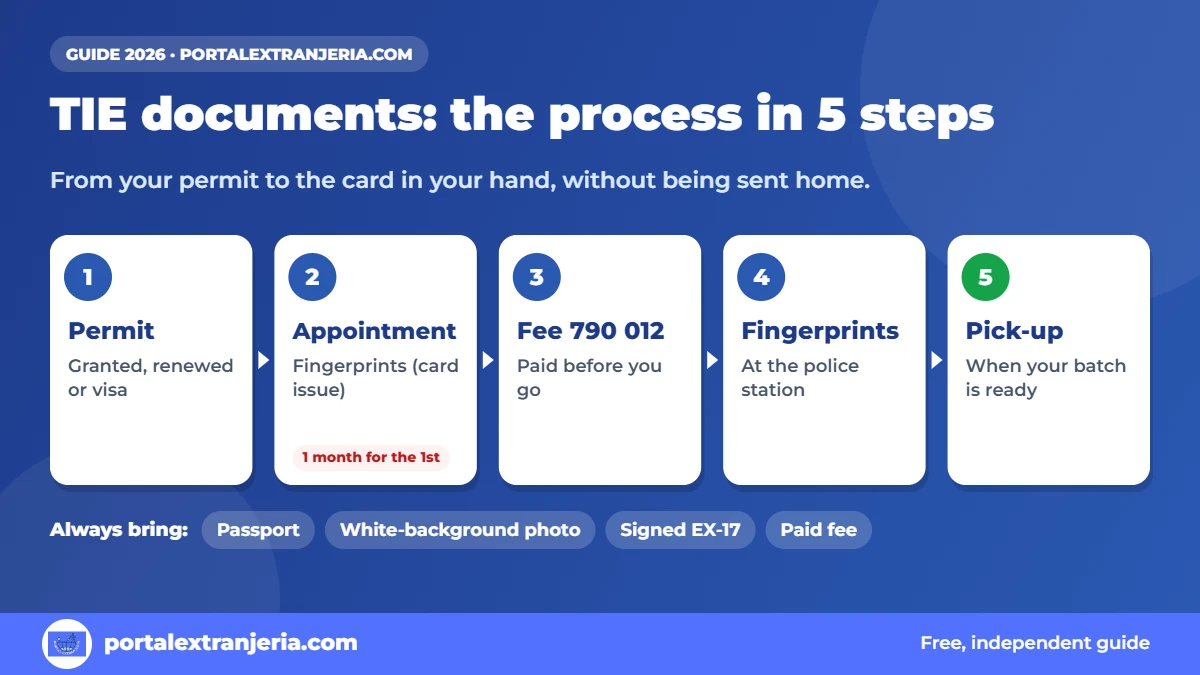
The whole TIE process at a glance
Whether it is your first card or a renewal, the road to having your TIE in your hand always goes through these five steps.
- PermitGranted, renewed or visa in your passport
- Appointment«Toma de huellas (expedición de tarjeta)»1 month for the 1st
- Fee 790 012Paid before the appointment
- FingerprintsAt the police station, with your papers
- Pick-upWhen your batch comes out
TIE documents for your first card (initial TIE)
Your residence has been granted (arraigo, work, family reunification, studies…) or you have entered Spain with a long-stay visa. Congratulations: now it’s time to apply for the card. You have one month from the day you are notified, or from the day you enter Spain if you come with a visa, to book the fingerprint appointment. Don’t leave it to the last week: in many provinces appointments go fast.
What you need to bring
- Form EX-17 (application for a foreigner identity card), filled in and signed.
- Valid passport, original and copy. If you entered with a visa, make sure the stamp or visa page is clear.
- Approval decision for your permit. Print it, even if you have it on your phone.
- A recent passport photo, in colour with a plain white background. No sunglasses or anything covering your face.
- Proof of payment of the 790 012 fee: €16.08 for the first TIE.
- Padrón certificate (empadronamiento), if your address has changed since you applied (some police stations always ask for it: bring it just in case).
- Appointment confirmation.
⚠️ If you miss the one-month deadline
You don’t lose your permit overnight, but you risk a fine and trouble proving you are legal. And without the physical card you can’t travel outside Spain or do many procedures. Book the appointment the same day you get the decision.
TIE renewal: documents and deadlines
Here is the most common confusion: a TIE renewal is really two procedures. First you renew your residence permit at the Immigration Office and, once it is granted, you apply for the new card with the Police, with its fingerprint appointment. If you only do the second one, there is nothing to renew.
When can I renew?
You can file the renewal in the 60 calendar days before your card expires. The law also lets you do it up to 90 days after it expires, but in that case you may face a sanction procedure. The sensible thing is to put the expiry date minus two months in your calendar and get started that day.
Where do I file it?
The fastest way is online, on the Mercurio platform or the immigration electronic office, with a digital certificate or Cl@ve; a lawyer or gestor can also file it for you. Otherwise, at the Immigration Office registry or any public registry. Keep the filing receipt: while it is being decided, together with your expired TIE, it proves you are legal.
Documents to renew the permit
- The form for your case (for example, EX-01 for non-lucrative residence). You have them all in immigration forms.
- Full valid passport and your current TIE.
- Proof of payment of the 790 052 fee for the renewal (the one that pays for processing the permit).
- The papers proving that you still meet the requirements of your permit. They change depending on the type:
A valid contract or work history showing you have worked, and being up to date with Social Security.
Self-employed registration up to date, payments to the tax office and Social Security, and the business still running.
Sufficient financial means, private health insurance with no co-payments and, since the 2025 Regulation, having lived in Spain more than 183 days a year.
The family member who brought you keeps their residence, means and housing; and school enrolment for minors, if any.
Then: the new card
When the renewal decision arrives, you book the fingerprint appointment and bring the same as for the first card, but with your old TIE and the renewal fee (€19.30). If after three months you have had no answer to the renewal, it is deemed granted by positive silence, and you can still apply for the card.
⚠️ Travelling while you renew?
With an expired TIE and the renewal receipt you are not always allowed back in. If you need to leave Spain before you have the new card, ask for a return authorisation (autorización de regreso) at the police station.
💡 Five years of legal residence?
You may no longer need to renew but to apply for long-term residence: a 5-year card, fewer papers and the long-term TIE fee (€21.87). And with 10 years (or 2 if you are from a Latin American country) you can think about Spanish nationality.
Fingerprints: how to book the appointment and what to bring
The fingerprint appointment is when the Police take your details (fingerprint, signature and photo) to make the card. You book it on the immigration appointment website: choose your province and the procedure «Policía – toma de huellas (expedición de tarjeta)». If you don’t see any slots, try early in the morning or another police station in your province.
TIE documents for fingerprint day
- Appointment confirmation.
- Form EX-17 filled in and signed.
- Original valid passport (and your previous TIE, if renewing).
- Approval or renewal decision.
- A recent passport photo with a white background.
- The 790 012 fee already paid: without the receipt they won’t see you.
- Padrón certificate, if your police station asks for it.
When you finish they give you a receipt with your batch number. Guard it with your life: you need it to know when the card is ready and to collect it.
Collecting the TIE: how to know it is ready and what to bring
The card usually takes a few weeks to be made. So you don’t go blind, check whether your batch has arrived in today’s NIE batches by province or sign up for our TIE batch alerts. In some provinces you also need an appointment to collect it: check before you go.
What to bring to collect the card
- The fingerprint receipt showing your batch number.
- Your original valid passport.
- Your previous TIE, if it is a renewal: they keep it at that moment.
Before you leave the counter, check that your name, date of birth and type of permit are spelled correctly. A mistake spotted there is fixed on the spot; six months later, it’s another procedure.
Lost, stolen, changes of details and expired TIE
Not everything is a first card or a renewal. These are the other cases you ask us about most:
Report it to the Police and book a fingerprint appointment for a duplicate, with the police report, passport, photo, EX-17 and the 790 012 duplicate fee.
You have to tell the Police about changes of address, marital status or nationality. With the new padrón and the EX-17 they can issue an updated card.
If you are within the 90 days after expiry, you can still renew (with a risk of a fine). After that, renewal is no longer possible and another route has to be looked at.
Going from student to worker, or from arraigo to employed work, is a modification of the permit, with its own forms and requirements.
🚫 Mistakes that get you turned away at the police station
We see them again and again. Go through the list before you leave home:
- Going without the 790 012 fee paid. You can’t pay it there. Pay it beforehand at the bank, an ATM or online.
- Ticking the wrong box on the fee. First TIE, renewal and long-term have different amounts.
- Bringing an old photo or one with a coloured background. It must be recent with a plain white background.
- Forgetting to sign the EX-17. Unsigned, it’s no good.
- Booking fingerprints before you have the decision. First the approval or renewal; then the card.
- Missing the one-month deadline for the first TIE or renewing late without knowing you can be fined.
- Travelling with an expired TIE without a return authorisation. You may not be let back in.
- Losing the fingerprint receipt. It makes it harder to know your batch and collect the card.
Frequently asked questions about TIE documents
What documents do I need for the TIE?
The basics are a valid passport, a passport photo with a white background, the signed EX-17 form and the paid 790 012 fee. On top of that, your permit decision (or visa) and, if you are renewing, your previous TIE.
How long do I have to apply for my first TIE?
One month from the day you are notified that your permit was granted, or from the day you enter Spain if you come with a long-stay visa.
How far in advance can I renew my TIE?
From 60 calendar days before it expires. It is also accepted up to 90 days after expiry, although in that case a sanction procedure may be opened.
How much does the TIE cost in 2026?
The 790 012 fee is €16.08 for the first TIE, €19.30 for a renewal and €21.87 for long-term residence. For a renewal you also pay the 790 052 fee for the permit.
Can I work or travel with an expired TIE while I renew?
If you filed the renewal on time, the receipt together with your expired TIE proves you are still legal and you can keep working. To leave Spain and come back, get a return authorisation first.
What happens if they don’t answer my renewal?
If three months pass with no answer, the renewal is deemed granted by positive silence and you can book the appointment for the new card.
How long until the TIE is ready after fingerprints?
Usually a few weeks, depending on the police station. You can check whether your batch has arrived on the NIE batches page for your province before going to collect it.
What do I do if I lose my TIE or it is stolen?
Report it to the Police and book a fingerprint appointment for a duplicate. Bring the police report, passport, photo, EX-17 and the 790 012 duplicate fee.
Official sources
This guide is checked against the Spanish Government websites. To start your procedures or read the regulations, always go to the official sources: