
Spanish nationality by residence 2026: requirements, how to apply and other routes
By the Portal Extranjería team · Updated on 30 October 2026 · Source: Spanish Civil Code, articles 17 to 26 (BOE)
Spanish nationality by residence is how most foreigners become Spanish: living legally in Spain for between 1 and 10 years, depending on your country and situation, having a clean criminal record and passing the CCSE and DELE A2 exams. Here you have the requirements, how to apply step by step to the Ministry of Justice (Ministerio de Justicia), how much it costs and the other routes to Spanish citizenship: marriage, option, origin and naturalisation by letter (carta de naturaleza).
Do I meet the requirements for Spanish nationality?
Find your route in less than a minute. We don’t store your answers.
Requirements for Spanish nationality by residence
To apply for Spanish nationality by residence you must meet all of these requirements on the day you submit your application:
- Legal and continuous residence in Spain for the years that apply to you (10, 5, 2 or 1), right before applying, with a valid TIE on that day.
- Good civic conduct: no criminal record in Spain or in your country of origin.
- Integration into Spanish society: a pass in the CCSE exam and, if your country is not Spanish-speaking, also the DELE A2.
- Documents from your country: birth certificate and criminal record certificate, legalised or apostilled and with a sworn translation.
- The fee paid: €104.05 with form 790, code 026.
- Once granted, swearing or promising loyalty to the King and obedience to the Constitution, and giving up your previous nationality unless your country has an agreement with Spain.
- ≈ €327official cost (CCSE, DELE and fee)
- 3–6 monthsto get everything ready
- 1–3 yearsof real waiting until the decision
If you don’t have the years yet, you may have another route: by option or by origin there are no exams and no years of residence, because they depend on your relationship with a Spaniard.
How many years of residence do you need for Spanish nationality?
The years must be of legal, continuous residence immediately before the application. They count from your first residence permit: time spent in an irregular situation does not count. The years depend on your case:
- 10 years · the general rule, for most nationalities.
- 5 years · if you have been granted refugee status.
- 2 years · if you are from an Ibero-American country (Brazil included), Andorra, the Philippines, Equatorial Guinea or Portugal, or of Sephardic origin.
- 1 year · if you were born in Spain, are married to a Spaniard, are the widow or widower of a Spaniard, were born abroad to a father, mother, grandfather or grandmother who were originally Spanish, were under the guardianship or foster care of a Spaniard for two years in a row, or did not use your right to nationality by option in time.
💡 Tip: take the exams and request the documents from your country a few months before you reach the years. That way you can apply on the very day you qualify and don’t lose any time.
How to apply for Spanish nationality by residence, step by step
Getting your application for Spanish nationality by residence right from the start is the best way to avoid a request for documents (requerimiento) that stops your file for months. This is the path:
- Exams: CCSE and, if it applies to you, DELE A2, from the Instituto Cervantes.
- Documents: birth certificate and criminal record, legalised and translated.
- Fee 790 code 026: €104.05, paid before you apply.
- Submit the application on the Ministry of Justice’s electronic office or at a public registry.
- Wait for the decision and, if it is favourable, take the oath within 180 days.
Step 1: the CCSE and DELE A2 exams
The CCSE is the exam on Spain’s Constitution and society (Conocimientos Constitucionales y Socioculturales de España). Every applicant over 18 takes it, including those from Spanish-speaking countries. It costs €85, has 25 multiple-choice questions taken from a public bank of 300, lasts 45 minutes and you pass with 15 correct answers. The result arrives in about 20 days and the certificate is valid for 4 years. You can practise with our CCSE test with all 300 questions (in Spanish, like the real exam).
The DELE A2 is the Instituto Cervantes Spanish language diploma. You only need it if your country is not Spanish-speaking, and a higher level (B1, B2…) is also valid. It costs about €138, has 4 parts (reading, listening, writing and speaking) and you need 30 out of 50 points in each of its two blocks. There are few exam dates a year (in 2026: February, April, May, October and November), registration closes 5 to 7 weeks before and results take 2 to 3 months. It never expires.
⏳ Do the DELE first. It is the slowest step of the whole process: between waiting for an exam date and waiting for the result, 4 or 5 months can go by, and if you fail you have to pay again.
Who doesn’t take the exams? Under-18s and people whose legal capacity has been modified by a court take neither. Nationals of Spanish-speaking countries don’t take the DELE, but they do take the CCSE. And anyone with the ESO or another official qualification obtained in Spain, or with an accredited disability or learning difficulty, can ask the Ministry of Justice for an exemption (dispensa): it is not automatic, you have to request it.
Step 2: documents for nationality by residence
This is where most files get stuck. Check every paper before you submit it:
- Valid passport (all pages) and your valid TIE.
- Birth certificate from your country, apostilled or legalised and with a sworn translation if it is not in Spanish.
- Criminal record certificate from your country, also apostilled or legalised and translated, and still valid on the day you apply.
- Census registration certificate (certificado de empadronamiento) from your town hall.
- CCSE and DELE A2 certificates, or the document proving you are exempt.
- Proof of payment of the fee 790 code 026.
- Depending on your case: marriage certificate, family book, birth certificate of your Spanish spouse, etc.
🗂️ The right order: first request the birth certificate, which doesn’t expire, and leave the criminal record certificate until the end, once you have passed the exams. That way it is still valid on the day you apply.
Step 3: fee 790 code 026 (€104.05)
This is the Ministry of Justice fee for processing your nationality. You fill in form 790 code 026 on its electronic office and pay it before submitting the application, at the bank with the printed form or online. It is not refunded even if your nationality is refused, so only pay when you have everything ready.
Step 4: where to submit the application
There are two ways. Online, on the Ministry of Justice’s electronic office, with a digital certificate or through a lawyer or agency (gestor) that submits it for you: this is the fastest option. On paper, at any public registry office of the Administration: it works, but entering your file into the system usually takes longer. When you apply you get a file number starting with R; keep it, because with it you can check how your application is going in «Cómo va lo mío».
Step 5: the decision and the oath
By law, the Ministry has one year to decide. If that year passes without an answer, the application is considered refused by administrative silence and you can appeal, although in practice almost all files take longer and end up being decided. If something is missing, you will receive a request for documents (requerimiento) with a deadline to provide it: always answer it on time. We explain how long Spanish nationality really takes and what each stage of the file means.
If it is granted, you have 180 days to swear or promise before the Civil Registry (Registro Civil); if you don’t, the grant expires. Then come the registration, the DNI and the passport: you have it all in what to do once your nationality is granted.
⚠️ The 5 mistakes that delay nationality the most
- An expired criminal record certificate on the day you apply. Request it last.
- Documents without an apostille or without a sworn translation. A normal translation is not valid.
- Different details on each paper, such as a surname or a date that doesn’t match your passport.
- Applying before you have the years, or with an expired TIE or one being renewed without proof.
- Registering late for the DELE and missing the exam date: it delays everything by several months.
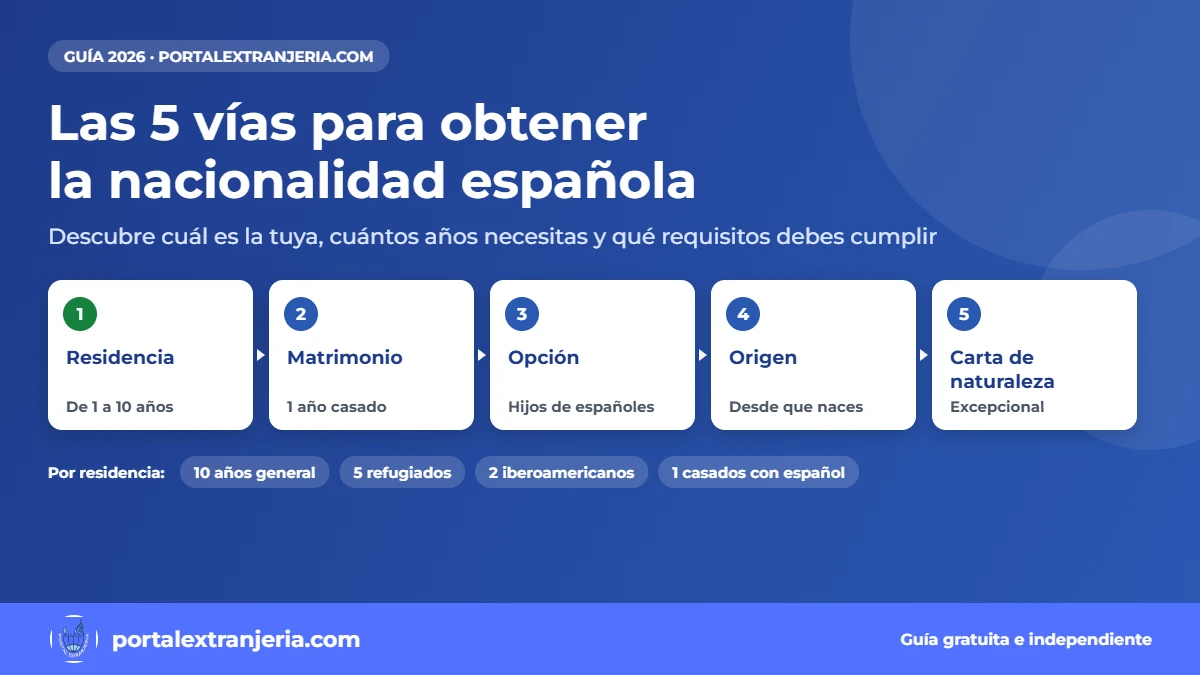
The 5 routes to Spanish nationality
Residence is not the only path. Knowing how to get Spanish nationality starts with choosing the right route: each one has its own requirements and is requested in a different place, and sometimes there is a shorter path than you think.
Spanish nationality by marriage: requirements
Marrying a Spaniard doesn’t give you nationality automatically, but it shortens the path a lot: you go from 10 years of residence (or whatever applies to you) to just 1 year. It is actually a form of nationality by residence, so you apply the same way and take the same exams.
- 1 year of legal residence in Spain, continuous and immediately before the application.
- 1 year married at the time of applying, without being legally or de facto separated.
- The marriage must be registered in the Spanish Civil Registry.
- The same requirements as everyone else: clean criminal record, CCSE, DELE A2 if it applies to you, and the fee.
If you are the widow or widower of a Spaniard and you were not separated when they died, 1 year of residence is also enough. A registered partnership (pareja de hecho), however, does not give you this short period: you need to be married.
The documents are the same as by residence, plus the full marriage certificate (certificado literal de matrimonio) from the Spanish Civil Registry and your spouse’s birth certificate, which proves they are Spanish.
Nationality by option: who can opt and up to what age
The option is a right that certain people have because of their relationship with a Spaniard. It is not a grant: if you meet the requirement, the nationality is yours just by declaring it before the Civil Registry or the consulate. What’s more, you don’t have to take the CCSE or the DELE. These people can opt:
- Those who are or have been under the parental authority of a Spaniard. The typical case is the minor children of someone who has just obtained nationality.
- Those whose father or mother was originally Spanish and born in Spain.
- Those adopted by a Spaniard when over 18, within two years of the adoption.
⏳ Watch the deadline. In the parental authority case, the option expires when you turn 20. If you miss it, you can still apply by residence with just 1 year. If your father or mother was originally Spanish and born in Spain, there is no age limit.
It is done with a declaration before the Civil Registry where you live or, if you live abroad, before the consulate. If the child is under 14, the parents or guardians sign it with the Registry’s authorisation; between 14 and 18 the child signs it, together with their legal representative. From age 14 you must swear or promise loyalty to the King and the Constitution and, except for countries with an agreement, give up your previous nationality.
Spanish nationality by origin: who is Spanish from birth
If you are Spanish by origin, you don’t have to apply for nationality: you have had it since you were born. You only need to register your birth in the Civil Registry, or at the consulate if you were born outside Spain. These people are Spanish by origin:
- Children of a Spanish father or mother, wherever they are born.
- Those born in Spain to foreign parents, if at least one of them was also born in Spain.
- Those born in Spain to stateless parents, or whose country doesn’t give them its nationality.
- Minors born in Spain to unknown parents.
- Minors under 18 adopted by a Spaniard: they are Spanish by origin from the adoption.
If your parents are foreigners and their country doesn’t give you their nationality, you can ask the Civil Registry for the declaration of Spanish nationality with simple presumption value (valor de simple presunción), a simple procedure that proves you have been Spanish since birth.
The special route for grandchildren of Spanish exiles under the so-called «ley de nietos» (Democratic Memory Law) is no longer open: the deadline to apply ended in October 2025.
Nationality by carta de naturaleza: when it is granted
This is the exceptional route. You don’t apply for it as a right: the Government grants it, at its discretion, by Royal Decree, when there are special circumstances. It has been used, for example, with renowned athletes and artists, with victims of the 11 March 2004 Madrid attacks and with former members of the International Brigades. If you are not in a situation like that, your path is residence, marriage or option.
Dual nationality: do you have to give up yours?
When you obtain nationality by residence, by option or by carta de naturaleza you must give up your previous nationality at the oath ceremony. But there are exceptions: if you are from an Ibero-American country, Andorra, the Philippines, Equatorial Guinea, Portugal or France, you can keep both.
Bear in mind that the renunciation is made before Spain. Whether your country still considers you its national depends on its own laws.
Frequently asked questions about Spanish nationality by residence
How many years do I have to live in Spain to apply for nationality?
Ten years in general, five if you are a refugee and two if you are from an Ibero-American country, Andorra, the Philippines, Equatorial Guinea, Portugal or of Sephardic origin. One year is enough if you were born in Spain, are married to a Spaniard or are the child or grandchild of Spaniards by origin, among other cases.
What are the requirements for Spanish nationality by residence?
Having lived legally in Spain for the time that applies to you, having no criminal record, passing the CCSE and, if you are not from a Spanish-speaking country, the DELE A2, providing your documents legalised and translated, and paying the €104.05 fee.
Where do you submit the application for nationality by residence?
On the Ministry of Justice’s electronic office, with a digital certificate or through a lawyer or agency, or on paper at any public registry office of the Administration.
Can I apply for nationality without a digital certificate?
Yes. You can submit it on paper at a public registry or ask a lawyer or agency, who submits it online with their own certificate.
How much does it cost to apply for nationality by residence?
The fee is €104.05. If you add the CCSE exam (€85) and the DELE A2 (about €138), the official cost is around €327, or about €189 if you don’t need the DELE, not counting translations and legalisations.
Can I apply for nationality by marriage without living in Spain?
No. Besides being married to a Spaniard for a year, you need one year of legal and continuous residence in Spain.
Does a registered partnership count for applying for nationality after one year?
No. The one-year period is for people married to a Spaniard. With a registered partnership (pareja de hecho), the period that applies to your nationality is used.
Do you have to take the CCSE and DELE on every route?
No. Only for nationality by residence, including by marriage. By option or by origin you don’t have to take any exam.
Is the «ley de nietos» still open?
No. The deadline to apply for nationality under the Democratic Memory Law ended in October 2025. If you are the grandchild of a Spaniard by origin and you live in Spain, you can apply by residence with one year.
What is consolidation or «posesión de estado»?
If you have held and used Spanish nationality in good faith for 10 years, based on a title registered in the Civil Registry, you consolidate it even if the title it was based on is later annulled.
Guides to continue with your Spanish nationality
Now you know how to get Spanish nationality and which route is yours. These guides help you with the next step: